

Table of Contents
We all love free things. Free shipping, free trials, free Wi-Fi at the airport, the word “free” has a magnetic pull that’s hard to resist, especially in the world of tech and networking. So when you stumble across a free proxy server that promises to mask your IP and unlock geo-restricted content at zero cost, it feels like a no-brainer.
But here’s the uncomfortable truth that most people learn the hard way: when you don’t pay for the product, you are often the product.
A free proxy might seem like a clever budget hack for casual use, but for anyone doing serious online work, scraping data, managing accounts, running ad campaigns, the security vulnerabilities, crawling speeds, and near-guaranteed bans make it a liability, not a solution. A premium residential proxy isn’t just a luxury upgrade; for many use cases, it’s a necessary investment.
This post breaks down exactly what separates the two, what you’re really risking by going free, and how to make the right call for your needs.
Understanding the Basics: What Are We Comparing?
Before diving into the risks, let’s get clear on what we’re actually talking about.
What is a Free Proxy Server?
A free proxy is typically a shared datacenter IP address made publicly available, no subscription, no sign-up, just a list of IPs you can copy and paste into your browser or tool settings. People search for the best free proxy server for understandable reasons: bypassing a basic geo-block, checking region-locked content, or just casual browsing without much at stake.
However, these proxies are almost always operated by anonymous entities with zero accountability. There’s no SLA, no customer support, and in many cases, no real understanding of who is running the server or why. They’re the networking equivalent of hitchhiking, it might work out fine, or it might not.
What is a Residential Proxy?
A residential proxy is fundamentally different. It’s an IP address that has been issued by a real Internet Service Provider (ISP) to an actual homeowner or device. When you route your traffic through a proxy residential connection, target websites see what looks like a completely normal human user browsing from a real home network.
If you’re still unfamiliar with how this works at a deeper level, it’s worth exploring What is a residential proxy to understand why these IPs behave differently from datacenter alternatives and why websites trust them more.
This distinction matters enormously. Websites have become extremely sophisticated at detecting datacenter IPs. A residential IP doesn’t trigger those alarms.
Why Free Proxies Are Dangerous: Risks You Need to Know
This is where the “free” label starts getting expensive.
Security Risks
The most alarming risk of using a free proxy server is what happens to your data in transit. Many free proxies log your traffic, inject advertisements into your browsing session, or worse, act as Man-in-the-Middle (MITM) attack vectors that intercept and steal login credentials, session tokens, and sensitive information.
Think about that for a moment. You open a free proxy to access a website, and the proxy operator now has a front-row seat to everything you type and submit. For casual browsing of a recipe site, maybe that’s an acceptable gamble. For anything involving accounts, payments, or proprietary business data, it’s a serious threat.
Free Proxy IPs Are Already Blacklisted
Free proxies are shared by thousands of users simultaneously, and not all of them have innocent intentions. Spammers, scrapers acting in bad faith, and bot operators all use the same free IP pools. The result? Those IPs get flagged, blacklisted, and blocked by major websites almost immediately.
By the time you’re using a free proxy, there’s a high probability the IP is already sitting on a blocklist at Google, Cloudflare, or whatever platform you’re trying to reach. You’re inheriting the sins of every bad actor who used it before you.
Slow Speeds and Constant Disconnects
Even if you somehow avoid the security and block-rate issues, the performance of a free proxy is genuinely painful. Overcrowded servers, shared bandwidth, and zero infrastructure investment translate to:
- Agonizingly slow load times
- High latency that makes automation tools time out constantly
- Frequent, unpredictable disconnects mid-session
For a one-off task with low stakes, this is just annoying. For a web scraping job or an e-commerce operation running at scale, it’s a business problem.
Why Residential Proxies Are Worth Paying For
Now for the good news: the problems above aren’t inherent to proxies, they’re inherent to free proxies. Residential proxy services solve all of them.
Residential IPs Are Trusted by Websites
Because residential IPs belong to real ISPs and real devices, they carry a level of trust that datacenter IPs simply can’t replicate. Websites that aggressively block datacenter traffic, social media platforms, retail sites, travel aggregators, treat residential IPs as normal users. This translates directly to dramatically lower block rates and fewer CAPTCHAs, which means your operations actually run.
Better Speed, Uptime, and Reliability
Top-tier residential proxy services maintain large, carefully managed IP pools with proper infrastructure behind them. You get meaningful bandwidth, high uptime guarantees, and the ability to rotate IPs intelligently, all of which are non-negotiable for any serious use case.
Ethically Sourced IPs
This one matters more in 2026 than it did even a few years ago. Leading providers now source their IP pools through transparent, consent-based networks, meaning the device owners have opted in. For businesses with compliance requirements or corporate ethics policies, this isn’t just a nice-to-have; it’s a requirement. Reputable residential proxy services will be upfront about how their networks are built.
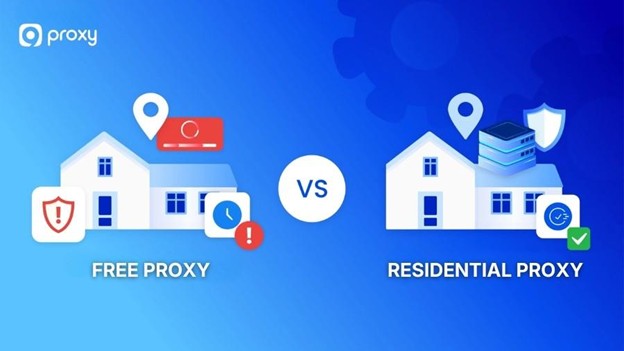
Free Proxy vs Residential Proxy: Side-by-Side Comparison
While free options look good on paper, the table below shows exactly why they often cause more headaches than they solve.
| Feature | Free Proxy | Residential Proxy |
| Cost | $0 | Monthly sub / Pay-per-GB |
| Anonymity | Low (easily detected) | Extremely high |
| Speed | Very slow / unstable | Fast / reliable |
| Security Risk | High (data theft, malware) | Minimal (encrypted, trusted) |
| Block Rate | Very high | Very low |
| Best For | Trivial, non-sensitive tasks | Scraping, SEO, e-commerce |
When to Use a Free Proxy vs a Residential Proxy
The honest answer is that free proxies aren’t universally useless, they’re just very narrowly useful.
A free proxy is acceptable when:
- You’re reading a geo-restricted news article and not logged into any account
- The task is completely one-off, non-sensitive, and failure has zero consequences
- You need to quickly verify that a piece of content exists in a specific region
You should use a residential proxy when:
- Web scraping at any meaningful scale, data extraction from sites that actively block bots
- Managing multiple social media accounts, platforms fingerprint and ban datacenter IPs aggressively
- Ad verification, checking how your ads appear in different markets requires IPs that won’t be flagged as bots
- Sneaker botting or limited-release copping, retail sites are among the most aggressive IP blockers on the internet
- SEO rank tracking, accurate SERP data from different regions requires clean, trusted IPs
- Any task where getting blocked means lost time or money
The pattern is clear: if there’s anything real at stake, a free proxy will cost you more in failure than a residential proxy costs in subscription fees.
How to Choose the Best Residential Proxy Service
Ready to invest in a proper solution? Here’s what to actually evaluate.
What Makes the Best Residential Proxy?
Not all residential proxies are created equal. When comparing providers, pay close attention to:
- Pool size: Larger pools mean more IP diversity and lower re-use rates, which keeps your block rate down. Millions of IPs is the baseline for serious providers.
- Geographic targeting: Country-level targeting is standard. For advanced use cases, look for city-level or even ISP-level targeting, which gives you surgical precision for localized tasks.
- Rotating vs. sticky sessions: Rotating proxies assign a new IP on each request (ideal for scraping). Sticky sessions maintain the same IP for a set duration (necessary for account management or checkout flows). You want a provider that offers both.
- Customer support: When something breaks at 2am during a critical run, you want a real support team. This is one of the clearest differences between a premium provider and a budget one.
How to Buy a Residential Proxy Safely
When you’re ready to buy residential proxy access, avoid the temptation to go through obscure forums or marketplace listings offering “cheap residential proxies.” These are often recycled datacenter IPs being mislabeled, or worse, they carry the same risks as free proxies.
Instead, look for established companies with:
- Transparent, published pricing (no hidden bandwidth fees)
- Clear documentation on how their IP network is sourced
- Verifiable reviews on independent platforms, not just testimonials on their own site
- Compliance documentation if your business operates in regulated industries
Established providers like 9Proxy are a good benchmark: transparent pricing, clear network documentation, and no hidden bandwidth fees are the baseline you should expect.
Your Checklist Before You Do a Residential Proxy Buy
Before committing to a subscription, run through this:
- Free trial or money-back guarantee: Legitimate providers offer a way to test before you commit fully
- Bandwidth rollover: Does unused bandwidth carry over, or do you lose it at month end?
- API access: Essential if you’re integrating proxies into automation tools or custom scrapers
- Dashboard and usage analytics: You should be able to see exactly what you’re using in real time
- Compliance with your region’s data laws: Particularly important for EU-based businesses under GDPR
Final Verdict: Is a Free Proxy Ever Good Enough?
The appeal of a free proxy is completely understandable. Zero cost, instant access, no commitment, it checks every “quick fix” box. But the actual math rarely works out in your favor. Between the security risks, the poisoned IP reputation, the unreliable performance, and the near-certain blocks on any website that matters, a free proxy server is often the more expensive option once you factor in time wasted and tasks failed.
For anything beyond trivially low-stakes browsing, residential proxy services are the professional standard for a reason. They offer the legitimacy, speed, and reliability that serious work demands, and in 2026, with platforms growing smarter and more aggressive about bot detection every month, that gap is only widening.
If your work depends on clean, reliable proxy access, don’t leave it to chance. Invest in the best residential proxy service that fits your use case, run through the checklist above, and spend your energy on the work itself, not on debugging why you’re blocked again.