


Table of Contents
Central air works well when the house was designed around it. But a lot of homes were not. Older properties, room additions, garages converted to living space, and guest rooms above detached structures all present problems that central systems handle poorly. The benefits of ductless mini splits become clear in exactly these situations.
This is not a case for replacing every central system. It is a guide to recognizing which spaces and situations call for a different approach.
Where Central Air Falls Short in Real Homes
Central HVAC was built around the assumption that a home has accessible attic space, a basement, or wall cavities large enough to run duct. Many older homes have none of those things. Running ductwork through a 1950s house often requires tearing into walls, ceilings, and floors to make it work.
Even in newer homes, the system is sized for the original footprint. A room addition or finished garage ends up at the far end of a long duct run, getting whatever pressure is left. That usually means too hot in summer and too cold in winter.
Central systems also cool and heat the whole house at once. If one person runs warm and another runs cold, the thermostat becomes a negotiation rather than a solution.
Spaces Where Zoned Comfort Changes Daily Life
Garages and workshops are the most common candidates. A space used as a gym, studio, or workspace needs independent climate control. Tying it into the main system rarely works and usually overloads a unit that was never sized for the extra square footage.
Guest rooms above garages or in detached structures face the same issue. Running ductwork to a space used sporadically is expensive and inefficient. A ductless unit in that room means the space is comfortable when needed and off when it is not.
Sunrooms and porches often get almost no airflow from the main system. They overheat in summer and chill in winter. A single ductless unit solves that without touching the existing setup.
Benefits of Ductless Mini Splits: Efficiency and Quiet Operation
Energy efficiency is one of the strongest arguments for ductless systems. Central systems lose a share of conditioned air through duct leaks before it reaches the room. Ductless units deliver air directly, meaning less waste and lower operating costs for the spaces they serve.
Quiet cooling is another feature that matters more than most people expect before they install one. The indoor unit runs at a whisper compared to the clicks and blasts of a central system cycling on and off. Technicians who specialize in ductless mini splits waco tx often hear from homeowners that they forgot the unit was running until they noticed the room had reached the right temperature.
Most ductless systems also allow each unit to be set independently. One room can be cooled to 68 while another holds at 74. That kind of control is not possible with a single-zone central system.
The Retrofit Case: Older Homes and Ductless Systems
Retrofit HVAC in an older home is one of the hardest problems a homeowner can face. Installing ductwork after the fact is expensive, disruptive, and often produces a system that still does not perform the way a purpose-built one would. Ductless systems sidestep all of that.
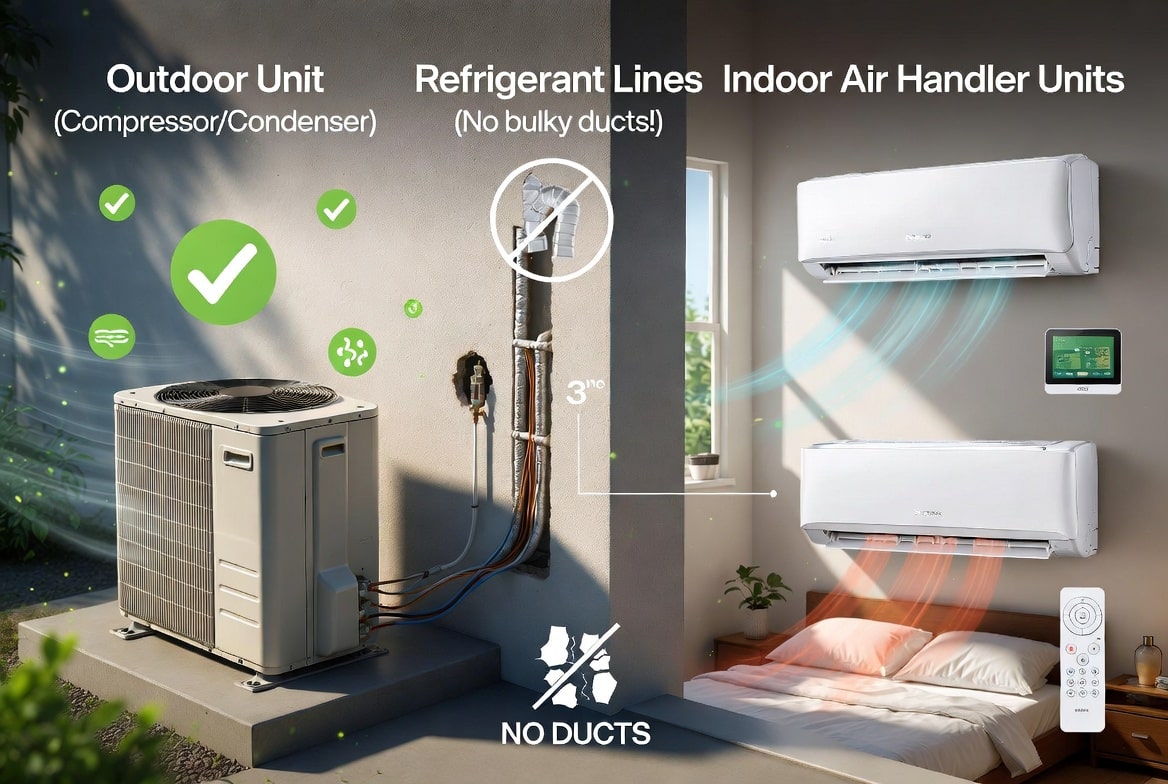
Installation requires only a small hole through an exterior wall for the line set connecting the indoor and outdoor units. There is no ductwork to run, no ceiling to open up, and no major renovation required. Most installations are done in a day.
For older homes in Central Texas, where many properties predate modern central air, ductless has become a practical first choice. The installation cost is typically far lower than a full duct retrofit.
Cost and Comfort Tradeoffs Worth Thinking Through First
Ductless units cost more upfront per zone than a simple window unit but far less than extending central ductwork. For a single room or a small addition, the math often favors ductless over both of those options.
Multi-zone systems, where one outdoor unit connects to several indoor heads, can cover multiple rooms. The cost scales with the number of zones, but so does the flexibility. A homeowner can cool a home office and a garage independently without a separate outdoor unit for each.
The tradeoff is appearance. Some homeowners find the wall-mounted indoor units less visually neutral than a ceiling vent. That preference is worth thinking about before committing to a particular room.
How to Know If Ductless Is the Right Fit
Ask two questions before deciding. First, does the space in question already have good airflow from the existing system? If yes, ductless adds cost without solving a real problem. If no, that is your answer.
Second, is the goal whole-home comfort or targeted comfort? Ductless excels at the second. For a whole-home replacement where ductwork is already in place and in good condition, upgrading the central system usually makes more sense than replacing it with ductless throughout.
The benefits of ductless mini splits are real, but they are most useful in specific situations. Match the system to the problem, not the trend. The right fit makes both the installation and the daily use feel obvious.