


Table of Contents
Phishing is the most reported cybercrime in the United States, and it has been for years. Yet despite constant warnings from banks, government agencies, and security researchers, the attacks keep working. People click fraudulent links, enter credentials on fake websites, and hand over personal information to criminals impersonating trusted institutions, every day, in enormous numbers. The question is not whether phishing works. The question is why it keeps working, who it affects, and what changed that makes today’s phishing attempts so much harder to detect than those of a decade ago.
The answers to those questions matter because phishing is not merely a technical nuisance. A single successful attack can be the first step in a chain of harm that includes account takeover, identity theft, fraudulent credit applications, and drained savings. Understanding what phishing actually is, how it works mechanically, and what forms it takes across different channels gives consumers a meaningful advantage in recognizing and avoiding it. That educational mission is one that OmniWatch has taken on directly, publishing a detailed glossary entry and reference guide on what phishing is and how it operates, aimed at giving everyday consumers the vocabulary and knowledge to protect themselves.
Phishing defined: deception, not code
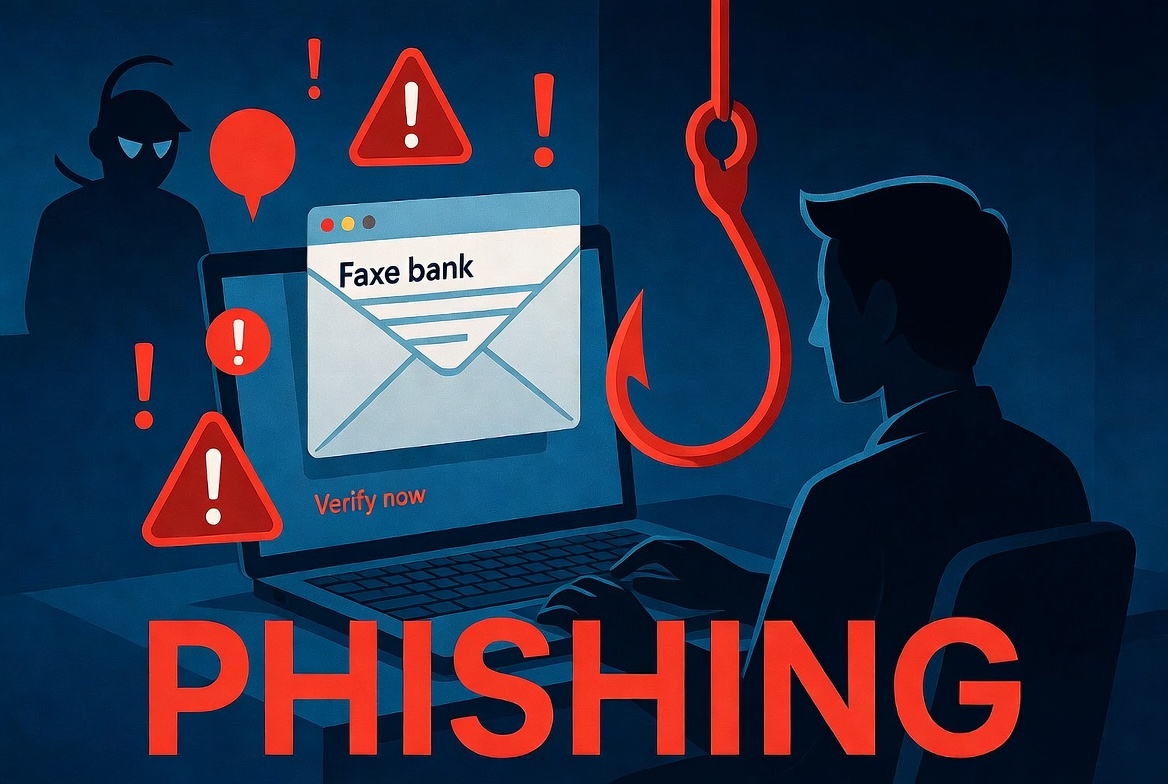
The term phishing, a deliberate nod to the act of fishing for victims, was coined in the 1990s by hackers targeting internet service provider accounts. The mechanics have grown considerably more sophisticated since then, but the core concept has not changed. Phishing is a cyberattack in which a criminal impersonates a trusted entity, such as a bank, a government agency, a delivery company, or even a known colleague, to persuade the target into taking a specific action. That action might be clicking a link, downloading a file, calling a phone number, or typing credentials into a fake website. The goal is almost always to capture information that the attacker can use to commit fraud or gain access to accounts.
What distinguishes phishing from most other forms of cybercrime is that it exploits human psychology rather than software vulnerabilities. A criminal does not need to defeat an organization’s firewall or bypass encryption if they can simply convince an employee to hand over their login credentials voluntarily. That human element is the reason phishing has remained the dominant form of cybercrime year after year. It works on the most carefully maintained systems because it does not attack the system at all. It attacks the person using it.
The FBI’s 2024 Internet Crime Report documented phishing as the most frequently reported complaint category, with hundreds of thousands of incidents filed that year alone. Adjusted for underreporting, the actual volume is believed to be vastly higher. Most victims never report phishing attempts, particularly when no financial harm results, meaning official tallies capture only a fraction of the true scope.
How a phishing attack unfolds
Breaking down a phishing attack into its component stages makes it easier to recognize where the deception is happening. The sequence is consistent across most attacks, even as the specific details vary by target, channel, and objective.
Choosing a target and crafting a story
Some phishing campaigns cast a wide net, sending identical messages to millions of email addresses at once. Others are surgically targeted at a specific individual or organization. The latter approach, known as spear phishing, involves research. The attacker reviews the target’s professional profile, employer, colleagues, and recent online activity to craft a message that appears entirely plausible within the context of that person’s life. A message appearing to come from a direct supervisor, referencing a real project, is far harder to dismiss than a generic bank alert.
Delivering the message
The delivery channel shapes how the message is framed and what defenses it needs to bypass. Email remains the most common vehicle, but phishing also travels via SMS text, phone call, social media message, and even QR code. Each channel exploits a slightly different set of habits and assumptions. Email phishing relies on people’s tendency to respond promptly to messages from brands they recognize. Text-based phishing, called smishing, benefits from the relative informality of the medium and the fact that most people are less critical of texts than emails. Voice phishing, known as vishing, leverages the persuasive power of a live human voice.
The call to action
Every phishing message contains a mechanism through which the attacker captures what they want. Most commonly, this is a link leading to a fake website designed to look exactly like the legitimate version of whatever organization is being impersonated. The site prompts the visitor to log in, and any credentials entered are transmitted directly to the attacker. Other attacks rely on attachments that install malware when opened, or phone numbers connecting to fraudulent call centers. The common thread is urgency. Most phishing messages create pressure to act immediately, before the target has time to pause and verify.
Using stolen data
Once a credential is captured or a malware payload is delivered, the attacker moves to the exploitation phase. Compromised login credentials may be used to access accounts directly, tested against other platforms through credential stuffing, or sold on dark web marketplaces to other criminals. Personal information collected through fake forms becomes raw material for identity theft. Any data that is not immediately useful to the original attacker typically finds a secondary market within hours.
The major variants: how phishing adapts to different channels
Phishing is not a single tactic. It is a category of social engineering that adapts constantly to exploit the communication channels people use. Knowing the variants makes them easier to recognize.
Email phishing
Mass email campaigns impersonating major banks, retailers, government agencies, and technology platforms account for the largest share of phishing volume. The messages typically warn of a suspended account, an undelivered package, a missed payment, or an urgent security alert. Recipients are directed to a convincing replica of the real website and prompted to enter their credentials. The technical infrastructure behind these campaigns can be assembled quickly and cheaply, which is why they persist despite high awareness.
Spear phishing
Spear phishing attacks are personalized and targeted. They account for a disproportionate share of the most consequential breaches, particularly those affecting businesses and organizations. A single successful spear phishing attack can yield access to corporate systems, executive email accounts, or financial transfer authorizations worth tens of millions of dollars. The investment in research that goes into crafting a convincing spear phishing message is repaid many times over when the attack succeeds.
Smishing
Text-based phishing has grown sharply as smartphone use has become nearly universal. Common smishing lures include fake package delivery notifications from carriers like FedEx and UPS, fabricated bank fraud alerts, and messages claiming a government agency needs to verify personal information. Short message format makes it easier to omit the telltale signs that give away email phishing, and the informality of texting lowers the guard that many people maintain around email.
Vishing
Voice phishing involves a caller impersonating a bank representative, IRS agent, Social Security Administration official, or technical support specialist. The caller uses pressure tactics, real urgency, and sometimes detailed personal information gleaned from prior data exposures to convince the target to reveal account numbers, PINs, or remote access to their device. Vishing is particularly effective against older adults, who report substantially higher losses per incident than younger age groups.
Whaling
Whaling is a high-stakes variant of spear phishing directed at senior executives or high-net-worth individuals. The sophistication and preparation involved are considerably greater than in mass phishing campaigns, and a single successful attack can result in losses of millions of dollars. Criminals targeting C-suite executives research their communication style, org chart position, active business relationships, and pending transactions to construct messages that are nearly indistinguishable from legitimate business correspondence.
Quishing
QR code phishing, called quishing, emerged as a significant threat when attackers recognized that QR codes mask their destination URL, making them difficult to scrutinize before scanning. Malicious QR codes have appeared in emails, physical mail, parking meters, restaurant menus, and public signage. Because most email security filters do not analyze QR code destinations, quishing bypasses defenses that catch traditional link-based phishing. According to data cited in OmniWatch’s phishing reference, QR code phishing attacks grew fivefold within a matter of months in 2024.
How AI transformed phishing
For years, the most reliable way to identify a phishing message was to look for what was wrong with it. Poor grammar, awkward phrasing, generic greetings, and formatting inconsistencies were the telltale signs. Security awareness training programs built entire curricula around teaching people to recognize those errors. The arrival of large language models in mainstream criminal toolkits rendered most of that training obsolete almost overnight.
Today, polished, grammatically correct, contextually appropriate phishing messages can be generated in seconds. Research cited by the Stevie Award-recognized team at OmniWatch notes that AI tools have compressed the time required to build a convincing phishing campaign from 16 hours to approximately five minutes. Multi-channel campaigns that combine email, SMS, and phone calls now achieve success rates roughly 42% higher than single-channel email attacks. Deepfake technology adds another dimension, enabling criminals to clone the voice of a family member, colleague, or executive and deploy it in a vishing attack that sounds, to the listener, like a familiar and trusted person.
The practical implication for consumers is significant. The heuristics that worked for identifying phishing a few years ago, checking for typos, looking for mismatched logos, and noticing generic greetings, are no longer sufficient. A phishing message today can be grammatically perfect, personally addressed, contextually relevant, and visually indistinguishable from legitimate correspondence. The only reliable defense is a combination of behavioral habits, technical tools, and verified verification processes that do not rely on the appearance of the message alone.
The link between phishing and identity theft
Phishing is frequently the mechanism through which identity theft begins rather than a standalone crime. When an attacker captures a set of login credentials through a phishing attack, the initial target is often the email account. Email access provides a springboard to everything else. Password reset requests for banking, investment, and insurance accounts are routed through email, so controlling someone’s inbox is functionally equivalent to controlling most of their digital financial life.
Phishing attacks that harvest Social Security numbers, birth dates, and financial account details through fake government or banking portals provide the raw material for synthetic identity fraud, tax fraud, and new account opening. The victim typically has no knowledge of the breach until tangible consequences appear, often months later, in the form of credit inquiries from institutions they have never contacted, debt collection notices, or rejection letters from lenders citing existing accounts that were never opened.
The scale of downstream harm is reflected in FTC data showing that consumers reported more than $12.5 billion in total fraud losses in 2024, a 25% increase over the prior year. Phishing is not the only mechanism behind those losses, but it is consistently among the most common entry points. The FBI’s 2024 Internet Crime Report specifically identified phishing-adjacent schemes, including business email compromise, as among the costliest categories, with losses in the billions attributed to attacks that began with an employee clicking a convincing fraudulent message.
Warning signs and how to read them
Even as phishing attacks have grown more polished, certain structural patterns persist. Recognizing them does not require technical expertise, only the habit of pausing before acting on any unsolicited message.
- Manufactured urgency: Messages claiming an account will be suspended, a package held, or legal action filed unless immediate action is taken are using urgency as a pressure tactic. Legitimate institutions typically provide substantial notice and multiple contact options before taking consequential action.
- Sender address inconsistencies: The display name of an email can be set to anything. The actual sending domain, visible when you click or hover over the sender field, reveals whether the message originated from the organization it claims to represent. A message appearing to come from a major bank but sent from a lookalike domain is almost certainly fraudulent.
- Generic salutations: Mass phishing campaigns address recipients as “Dear Customer” or “Dear User” because the messages are sent to thousands of people without individualized information. A legitimate notification from a company you have an account with will typically address you by name.
- Requests for sensitive information: Banks, government agencies, and legitimate businesses do not ask for passwords, PINs, or Social Security numbers by email or text. Any message requesting this information through those channels should be treated as fraudulent.
- Unexpected attachments: Files attached to unsolicited emails, or files forwarded from contacts whose accounts may have been compromised, can contain malware. When in doubt, do not open the attachment, and contact the supposed sender through a verified channel to confirm.
- URL destination mismatches: Before clicking any link in a message, hover over it to preview the actual destination URL. If the URL does not match the claimed sender’s official domain, do not click. Navigate directly to the organization’s website instead.
Steps to take after clicking a phishing link
Acting quickly after a phishing interaction significantly limits potential damage. The response should begin before the full extent of the harm is known.
Close the tab immediately without entering any information if the link led to a web page. Change the password for any account the message was impersonating, ideally from a different device. Enable multi-factor authentication on that account if it is not already active. Run a malware scan on the device used, particularly if a file was downloaded or the site appeared to attempt a software installation. Check other accounts sharing the same email address or password for unauthorized activity, and contact financial institutions directly if any account credentials or payment information may have been entered.
Report the incident to the Anti-Phishing Working Group at reportphishing@apwg.org and to the FTC at ReportFraud.ftc.gov. If any personally identifying information was captured, including a Social Security number or date of birth, placing a credit freeze at the three major bureaus is a prudent next step.
OmniWatch’s role in protecting consumers from phishing
OmniWatch addresses the phishing threat both through education and through purpose-built detection tools. The company’s Scam Protection Center allows subscribers to submit emails, text messages, URLs, QR codes, and images for analysis, with the platform returning a determination of whether the submitted content appears legitimate or fraudulent. For Gmail and Outlook users, the service can connect directly to the inbox and automatically scan incoming messages for phishing indicators before the user ever interacts with them.
Reviewers at AllAboutCookies noted that the company “excels at scam protection, offering built-in tools that help detect phishing attempts, even on mobile devices,” rating the service 4.5 out of five stars based on hands-on testing. The review highlighted the scam scanner’s ability to flag suspicious content that standard email providers miss, a capability that matters increasingly as AI-generated phishing messages bypass conventional spam filters.
Analysts at CyberNews described OmniWatch’s Standard plan as including “AI-powered scam detection for texts and emails” alongside dark web monitoring, credit monitoring, and identity theft insurance, noting the service’s approach of bundling phishing detection with broader identity protection as a differentiator from services that address only one part of the threat.
The iLounge publication noted OmniWatch’s Gold Stevie Award for Company of the Year at the 2025 American Business Awards, where judges recognized the company’s industry-leading insurance coverage and its scarcity of comparable ransomware and social engineering protections in the broader market. The award and the recognition around it reflect a judgment that OmniWatch occupies a distinct position in addressing modern threats, including phishing, that legacy identity protection services were not designed to handle.
Why phishing education matters as much as technical defenses
Technical defenses against phishing, including spam filters, email authentication standards like DMARC and DKIM, and AI-powered anomaly detection, have all improved substantially in recent years. They catch a meaningful share of fraudulent messages before they reach inboxes. But they do not catch all of them, and attackers continuously adapt their methods to stay ahead of detection systems. The AI-generated campaigns that now dominate phishing volumes are specifically engineered to defeat pattern-matching filters by varying phrasing, sender infrastructure, and message structure.
This is why consumer education is not a secondary concern or a fallback when technology fails. It is a primary line of defense. A person who understands what phishing is, how urgency and impersonation are used as levers, and what structural signs to look for will catch attacks that no filter will. The combination of informed human judgment and capable technical tools provides substantially stronger protection than either alone.
OmniWatch’s investment in consumer-facing resources, from its phishing glossary to its broader library of guides on identity theft, scam tactics, and digital security practices, reflects a recognition that the protection gap is as much educational as it is technological. A subscriber who understands why a message asking for their bank credentials over email should never be trusted is far less likely to become a victim, regardless of what technical safeguards are in place.
The threat landscape for phishing will continue to shift as AI tools become more capable and as criminals find new channels and new psychological angles. What remains constant is the underlying mechanism: an attacker using deception to persuade a person to act against their own interests. Understanding that mechanism in detail is, ultimately, the most durable form of protection available.