


Table of Contents
During the golden age of the 1990s, being a fan of Star Trek was an easy, though at times exasperating, task. You programmed your VCR to tape at 7:00 PM on the show, Deep Space Nine, or you watched a marathon of the Next Generation on a cable TV channel such as Spike TV or TNN. It was cozy to the model of the appointment television, though it entailed being at the mercy of local affiliate schedule or the monthly bill increase by a cable service company. However, as we head a little deeper into 2026 the last frontier is not just a location that Kirk or Janeway will be visiting, but how we will be viewing that.
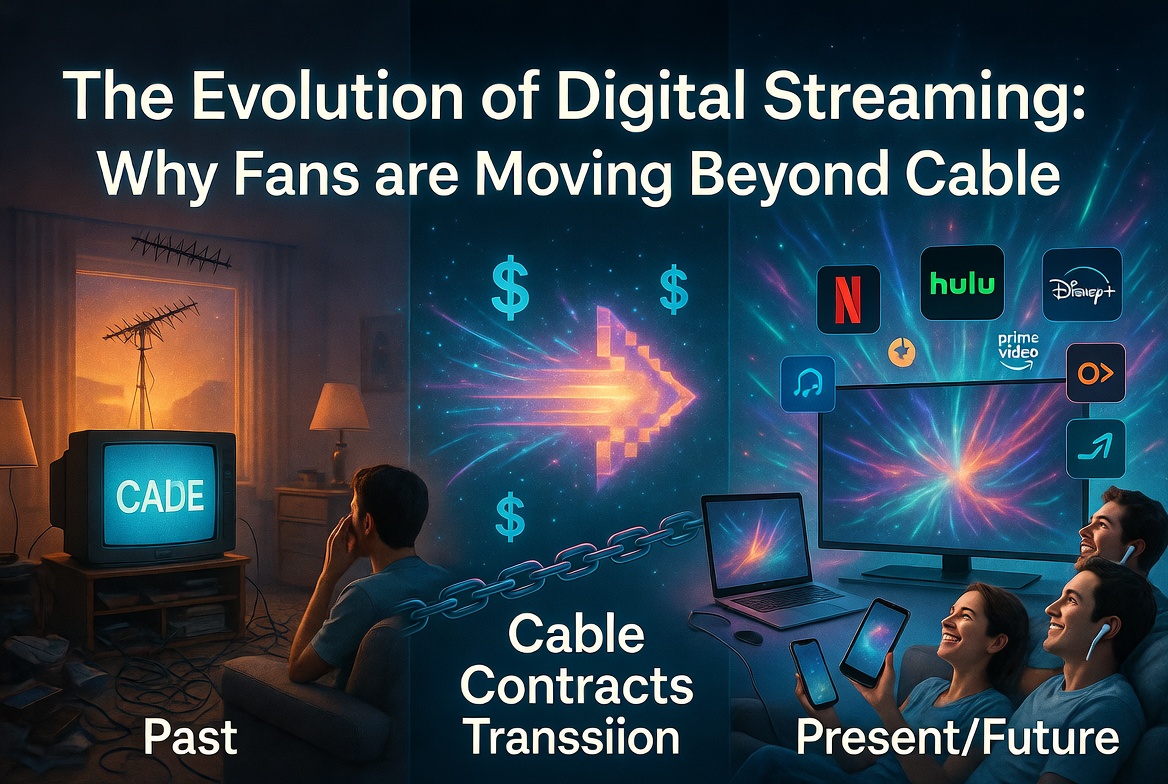
The Great Cord-Cutting has not been an old-fashioned exodus; it has been a rocket-ship change. Since the 1970s, the cable companies had enjoyed a monopoly on high-end science fiction. You could get the home shopping and golf you never picked up, and to do so, you had to spend more on a package that included the high-budget thrills of Battlestar Galactica or the philosophical depth of The Expanse. The landscape today is not recognizable. No longer is the fan attached to a wire in the wall. Digital streaming has enabled viewers to create their own Federation of Content, focusing on flexibility, worldwide availability, and community-based websites.
The Protocol: The Term Used for This Emergence
The advanced technology of the current delivery systems is a key impetus towards this change. Although early streaming was a shaky simulation of a holodeck, modern IPTV offerings have become stable ecosystems that resemble the stability of traditional broadcasting without the limiting contracts. These services, because they use Internet Protocol to send data, enable fans to receive live feeds and huge back-catalogs with the same instant-on response that we had once gotten used to with a coaxial cable.
In the case of the Trekker, this translates into the regional blackouts and the syndication wait being over. Previously, when a new show premiered on a network that your local cable company did not carry, you were just out of luck or had to wait months to get the show on DVD. The internet has now successfully flattened the globe. The latest adventures of the Enterprise or the Stargazer are known in the same instant, in high-rise, London, or ranch, Montana. This has made a fragmented audience a genuine global community through such a democratization of access.
Content Bundling vs. Content Curation
The biggest grievance with the “Cable Era” was the lack of choice. You have paid a package of silver tier to get one sci-fi channel. This was originally addressed with streaming services such as Paramount+, Netflix, and Disney+, which provided friendly but specialized silos, but the market became oversaturated, and fans began to seek more end-to-end experiences.
Get to the next stage of the evolution: the all-in-one digital interface. Contemporary audiences are flocking to platforms that bundle their preferred niche genres into one, smooth UI. The popularity of the concept of IPTV as a way to take all these disparate streaming applications and unify them into a unified format of a program guide is gaining some traction again. Fans do not want to swipe through half a dozen apps to find the particular episode of Strange New Worlds they are after; they want an app that acts like the LCARS interface on a starship: intuitive, quick, and all-encompassing.
Moreover, the emergence of so-called FAST (Free Ad-supported Streaming TV) channels has imitated the element of comfort food of cable. Something about having a 24/7 Star Trek channel where you do not need to select an episode, instead you just drop in wherever Picard is going to go, is a uniquely satisfying experience. It employs the chance of old channel surfing without paying the $150-a-month cost.
The Social Frontier
The social integration offered by digital platforms is perhaps the biggest factor driving fans out of cable. Cable was a unidirectional broadcast; streaming is a discussion. In 2026, a premiere is not something that is viewed alone. It includes Watch Parties, live Discord chats, and instant reaction videos.
Streaming services have gone in this direction by adding social functionalities right into the experience. We no longer speak about the next day at the water cooler but rather live-tweet about the present second (or the analogous 2026 version). Cable was just not able to match this amount of interactivity. When a big lore unveiling occurs, such as a long-lost legacy character returning, the internet goes nuts in a way that a cable broadcast could not. TV is no longer a passive medium; it has become an event-based, participatory experience with digital streaming.
We Are Looking into the Future, and it is a Wonderful Place
It is obvious as we cast our eyes to the horizon: the black box on top of the TV is turning into a monument of a past age, just like the floppy disk or the cassette tape. Decentralized, high-speed, and hyper-personalized delivery is the future. The effectiveness of the IPTV and advanced streaming applications makes sure that the viewer, not the provider, is in the captain’s seat.
We no longer feel confined by the confines of “Prime Time.” In a fandom that has always been looking to the future and promoting the notion of Infinite Diversity in Infinite Combinations, the shift towards the inflexible, monolithic format of cable TV was unavoidable. We have now come to a stage where our technology is aligned with our imaginations, and we can access the stories we love, whenever and wherever we are in the galaxy. Cable was a good ship of its day, but in the present age we have discovered a better method of flying.