


Table of Contents
We have heard dozens of times that the casino of the past, the one we knew from Hollywood movies and some of us perhaps from personal experience, has stayed in the past forever. In the meantime, digital casinos have risen as a new form of entertainment, and more. But land-based casinos are still important, and they continue to change the experience they offer.
They are also changing the fruits, desserts, and other foods they serve, not in slot machines, but in the restaurants that have become part of the casino night.
Why the menu became part of the main event
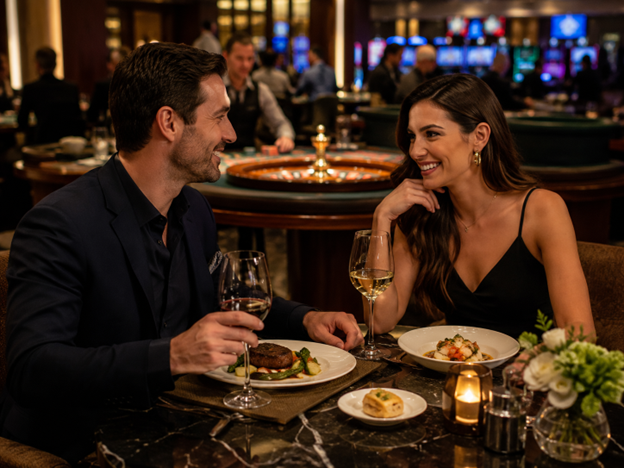
The clearest sign of change is the role of casino food itself, and if you check out this casino food and dining guide you will see how it illustrates that venues pay a lot of attention to this, often even attracting world-class chefs. Without a doubt, it now works as part of the venue’s atmosphere, almost like lighting, music, or interior design. A coffee bar creates one pace, a steakhouse another, a noodle counter another, and a lounge menu something else again. In that sense, casino food has become a tool for shaping how guests move, pause, gather, and return.
That wider role changed the food’s design. Older formats often leaned on:
- scale
- large batches
- long holding windows
- broad appeal built for minimal friction.
Preparation methods followed that logic. Instead of relying only on big production, kitchens now lean more on staged prep and fast finishing. Sauces may be made ahead but added later. Proteins may be portioned early, then cooked or glazed close to service. Garnishes are used with more care because visual detail now matters more. Items that need to travel across a property are built to keep texture and temperature longer, which affects everything from bread choice to fry style to container design.
Burgers moved from simple stacks to crust, balance, and the reverse burger
Burgers in casino venues have changed because cooks now treat them like serious dishes, not just quick comfort food.
Before, the main idea was often size: a big burger, a big bun, and a lot of toppings. Now, chefs care more about:
- how crispy the meat gets,
- how juicy the center stays,
- how soft but strong the bun is,
- and how each layer tastes in one bite.
Even onions matter more now. Some are cooked slowly until they become sweet. Others are smashed onto the hot grill with the meat, so they add both sharp flavor and extra juiciness.
One clear example of this change is the reverse burger. It is not one exact recipe. It usually means an inside-out or flipped version of a burger. Instead of the normal order of bun, meat, cheese, and sauce, the cook changes the structure so the first bite feels different.
Steakhouse favorites now show more fire, more resting, and cleaner finishing
Another big food change can be seen in casino steakhouses. Instead of only giving the steak a hard sear and heavy sauce, kitchens often build flavor in steps:
Original visual material, specifically created for this article.
Resting matters because the steak cuts more cleanly and keeps more juice inside, and that’s what you would almost certainly be served in well-rated steakhouses in general.
Guests want speed, choice, and quality at once
One reason dining changed so much is that guest expectations now pull in several directions at the same time. In large entertainment properties, food has to work in motion. People want a meal at the table, a snack between activities, and service that still feels smooth when they are not sitting in a formal dining room.
The broader restaurant industry is showing the same pattern, with nearly 75% of all restaurant traffic now happening off premises, 94% of consumers saying speed is critical, and 90% saying they would order a wider variety of items if quality held up during delivery. At the same time, consumer trend research for 2025 found that price was the top factor in food choice for 79% of respondents, followed by taste at 58%, nutritional content at 46%, and convenience at 37%.
| What diners now expect | Data | What it changes in casino venues |
| Speed beyond the dining room | 75% of restaurant traffic is off premises; 94% say speed is critical | Menus need items that can move fast without losing structure or appeal |
| More variety with reliable quality | 90% would order more broadly if delivered food kept on-premises quality | Preparation shifts toward dishes that travel well across the property |
| Value without giving up enjoyment | 79% price, 58% taste, 46% nutritional content, 37% convenience | Kitchens balance comfort, freshness, and portion logic more carefully |
Preparation now favors consistency across the property
The next big shift is in the kitchen itself. The strongest preparation systems today are not only about craft in the classic sense. They are about control across many service points. The National Restaurant Association’s 2025 culinary forecast put sustainability and local sourcing at the top of its macro trends, while also pointing to smaller menus, convenience proteins, and AI integration.
As Chad Moutray put it, “They extend beyond what’s on the plate to convenience, creativity, and efficiency.” That helps explain why more venues now rely on pre-portioned proteins, staged prep, and faster finishing methods that keep quality steady while making service more flexible.
Technology matters more in multi-space venues
Technology is reinforcing that direction. National Restaurant Association research found that 76% of operators believe technology gives them a competitive edge, while 60% plan tech investments to improve the guest experience and 52% plan them to boost productivity or efficiency in the kitchen.
The data presented by the National Restaurant Association shows the role of technology across restaurant services, as well as adoption among different generations of customers.
Consistency becomes the real standard across the property
For casino venues, that kind of investment matters because dining is spread across multiple spaces at once. Better kitchen screens, payment flow, inventory systems, and timing tools do not just speed things up. They help one property deliver a meal that feels consistent whether it is eaten at a bar seat, in a dining room, or elsewhere on site.
Final Point
Dining in casino venues changed because the meal now carries more of the venue’s promise. Preparation methods changed because the kitchen has to support that promise with speed, range, and consistency all at once.