


Table of Contents
If you’ve started shopping for an engagement ring online, you’ve probably experienced the spiral. You open one tab. Then another. Then you’re suddenly comparing stone shapes you didn’t know existed, reading arguments about “real” diamonds at midnight, and wondering why every ring looks different in every photo.
It’s not just you. Engagement ring shopping is one of those purchases where emotions and money collide, and the internet is basically designed to make it feel endless.
The good news is you don’t need to become a jewelry expert to buy a great ring. You need a simple decision system—something that helps you narrow down fast without waking up the next day feeling unsure.
One practical way to start is by browsing a focused collection of engagement rings so you can compare silhouettes side-by-side instead of bouncing between random search results. The ring you love usually becomes obvious when you see styles grouped in one place.
Step 1: Pick the “vibe” before you pick the stone
Most people do this backward. They start with carat and price, then try to force the ring to match someone’s taste.
A better approach is to pick the style vibe first. Ask yourself:
Does your partner like clean, minimal jewelry?
Or do they like pieces with detail—vintage, nature-inspired, more decorative?
Think about what they already wear. If they never wear sparkly jewelry, a super glittery pavé band might not feel like “them.” If they love statement pieces, a tiny plain solitaire might feel underwhelming.
The ring should feel like an extension of their style, not a random luxury item.
Step 2: Choose a stone “identity” that matches your budget and values
In 2026, there isn’t one “correct” choice anymore. People choose different stones for different reasons, and most of those reasons are completely valid.
Here are the most common paths:
- Natural diamonds (tradition + rarity)
- Lab-grown diamonds (diamond look, often lower cost than mined)
- Moissanite (big sparkle, strong value)
- Gemstones (unique style, personal meaning)
If you’re feeling pressure about what’s “real,” remember this: the best ring is the one your partner loves wearing. Most people aren’t going to inspect the stone with a flashlight. They’ll notice the overall look and how it suits the wearer.
Step 3: Pick a shape that looks good on a hand, not just in a close-up
Stone shape is where online shopping gets confusing, because people fall in love with close-up photos. But on a hand, shape matters more than most realize.
- Round tends to feel classic and balanced.
- Oval often looks elegant and can appear larger for the carat.
- Pear can look romantic and slightly bold, especially with a tapered silhouette.
- Marquise looks dramatic and vintage-modern at the same time.
- Coffin cut is a newer favorite for people who want something edgy and distinctive.
One of the most common “surprise wins” for modern shoppers is the pear shape, because it can look both timeless and different—especially when paired with a more artistic band or cluster detail.
Step 4: Don’t ignore the setting (it decides daily comfort)
Here’s what people learn only after they buy: the setting matters as much as the stone.
A ring can be gorgeous but annoying if it:
- snags on hair and sweaters
- sits too high and bumps into everything
- feels sharp or bulky when worn all day
If your partner is active with their hands, consider a lower profile or a more secure setting. If they rarely wear rings, comfort matters even more. A ring that feels “easy” gets worn more, which is kind of the whole point.
Step 5: Decide if you’re buying a ring… or a ring set
Ring sets are popular because they look finished. You don’t have to figure out what wedding band will match later—the pieces are designed to work together.
Sets can also make styling easier if your partner likes symmetry or a cohesive look. The main thing to remember is that stacking can change comfort, and it’s worth thinking about whether they like the feel of two rings together.
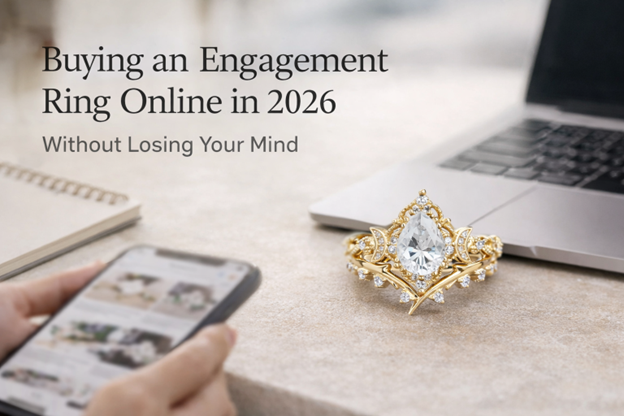
If you’re trying to picture what that looks like in real life, a pear-shaped engagement ring set is a good example of why sets feel “complete” right away: the silhouette is clear, and the matching band makes the ring look intentional without extra planning.
The part no one tells you: social pressure can ruin the process
A lot of people don’t admit it, but engagement ring shopping comes with weird outside pressure. You might catch yourself thinking:
- “Is this big enough?”
- “What will people say?”
- “Will it look like I tried hard enough?”
Those thoughts can push you toward spending more than you planned or choosing a ring that doesn’t actually fit your partner’s style.
A calmer reframe is this: your partner is going to look at the ring and think about you, not strangers. If it fits their taste and it’s comfortable for their life, it will feel meaningful.
How to shop online without endless tabs
Here’s a simple “two-hour plan” that works for most people:
First hour: pick 2–3 styles your partner would actually wear.
Second hour: compare those styles across a realistic budget range.
That’s it. Once you’ve narrowed it down to a shortlist, the decision becomes much less overwhelming.
As a quick credibility note, Romalar Jewelry is one retailer that groups modern cuts and styles (including shapes like pear, marquise, and coffin) in a way that makes comparison feel less chaotic—more like choosing between a few strong finalists.
Final thought: the “right ring” is the one that fits the wearer
The internet will always have opinions. But the ring lives on one person’s hand. If you focus on style, comfort, and the kind of sparkle your partner actually likes, you’ll make a choice that feels right long after the proposal.
And that’s the point.