

Table of Contents
A room can look perfectly fine and still be quietly heading toward a very expensive problem.
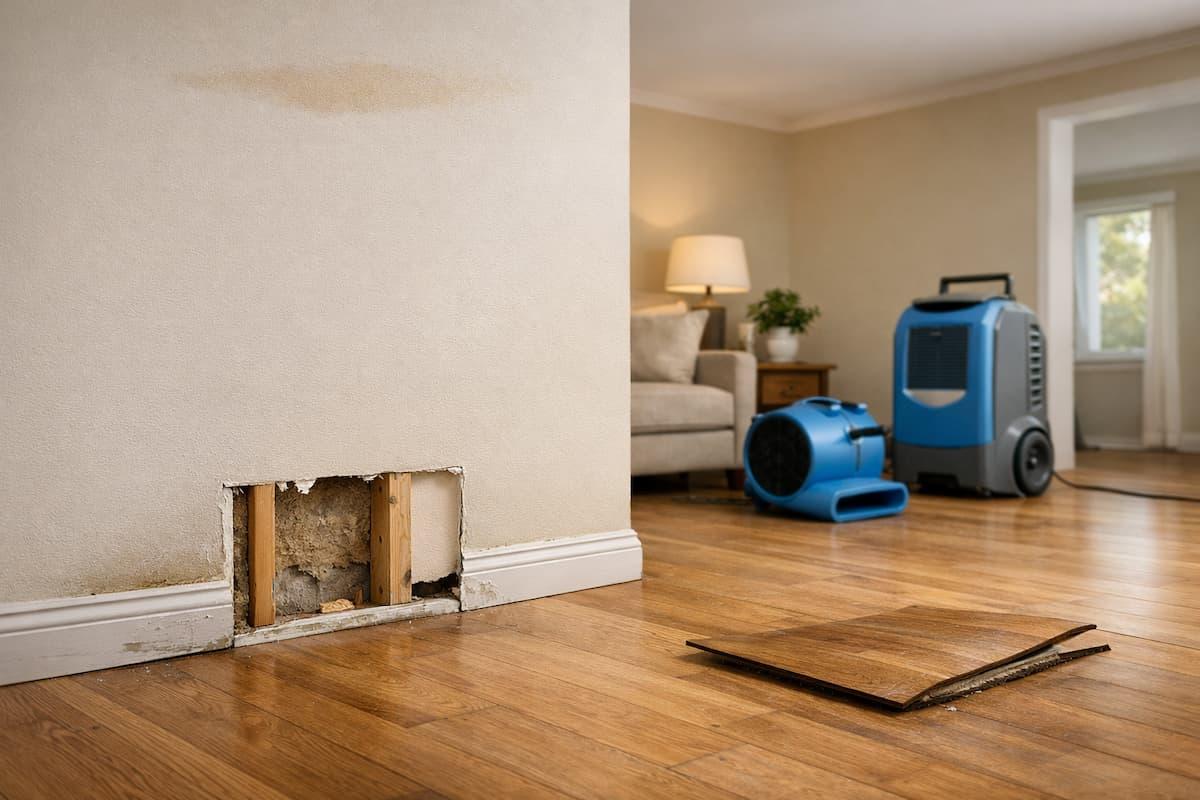
That is one of the more frustrating truths about water damage. A floor may no longer feel wet. The stain may stop spreading. The air may even lose that unmistakable “something’s off here” smell. But moisture has a talent for sticking around in exactly the places people cannot see: behind baseboards, inside wall cavities, under flooring, around insulation, and in the little seams where building materials meet and trap trouble.
That is why homeowners often panic too late. The emergency feels over once the visible water is gone, even though that is usually the moment the more complicated part begins. A reputable restoration company in Boston or any experienced damage specialist will tell you the same thing: appearance is a terrible moisture meter.
Surface dryness is not structural dryness
People are understandably visual about house problems. If the ceiling isn’t dripping and the rug doesn’t squish underfoot, the situation feels under control. Unfortunately, water does not care about that logic.
Drywall, subfloors, framing, insulation, and trim can all hold moisture long after the obvious mess disappears. Wood absorbs it. Drywall wicks it upward. Insulation loves to stay damp in private. Even tile floors, which seem reassuringly waterproof, can hide moisture in the layers below if water found a way through the grout lines or under the edges.
This is why a seemingly modest incident can behave like a much bigger one. A dishwasher leak that ran overnight may affect cabinetry, subflooring, and the wall behind the appliance. A toilet overflow can move into adjoining rooms more easily than people expect. A basement seepage issue can quietly raise humidity levels enough to affect stored items, lower wall sections, and even air quality on upper floors.
The house may look calm. The materials may be staging a slow rebellion.
The real damage usually starts after the puddle is gone
Water damage has a peculiar timeline. The dramatic part happens first. Then comes the boring part, which is actually the dangerous part.
In the first phase, everybody notices the problem. There is water on the floor, maybe a stained ceiling, maybe a panicked attempt to save a rug that was probably never going to make it. In the second phase, homeowners shift into cleanup mode: towels, fans, open windows, a wet vac if they are feeling ambitious.
Then comes the false sense of closure.
What many people miss is that residual moisture creates conditions for swelling, warping, delamination, odor, and microbial growth. Hardwood boards cup. Laminate edges puff. MDF trim turns fluffy and tragic. Paint begins to blister. The underside of materials stays cooler and wetter than the room around it, which slows proper drying and gives mold a nice head start.
This is especially true after larger weather events or foundation-related flooding. Homeowners dealing with flood damage restoration in Boston often assume the main issue is getting standing water out of the basement or first floor. In reality, the cleanup is only part of the story. The more important question is what the water touched, how long it sat there, and what absorbed it before anyone noticed.
That is where two homes with the “same” problem can end up with very different repair bills.
Mold does not need a disaster to become a problem
One of the most persistent myths around mold is that it only appears after catastrophic flooding or in visibly neglected houses. Not true. Mold is much less dramatic than that, which is part of what makes it annoying.
A clean, well-maintained home can still develop mold if damp materials stay enclosed long enough. A pinhole plumbing leak behind a wall. A slow roof leak around flashing. Condensation around poorly insulated ductwork. A finished basement that never quite dries after minor seepage. None of these make for an especially cinematic homeowner story, but they do create real conditions for growth.
And mold does not always announce itself with a giant black patch creeping across the wall like a villain in a home-improvement horror movie. Sometimes the clues are subtler: a persistent earthy smell, a room that always feels “off,” recurring paint issues, or a family member who seems to get more irritated in one area of the house than elsewhere.
This is also where delayed action becomes expensive. The longer moisture stays hidden, the more likely the solution shifts from “dry and monitor” to “remove and rebuild.” People rarely enjoy hearing that a section of wall needs to be opened because it looked fine last week. Houses are rude that way.
Not every property problem stays neatly residential
Water damage has a way of crossing categories. A homeowner may think they are dealing with a simple residential issue until they realize the affected space includes a home office with equipment, a basement rental unit, a mixed-use property, or a condo building where the problem spread beyond one wall and one owner.
That is when the scope changes. In those situations, the right help may look different than it would for a single-room cleanup, particularly if shared systems, liability concerns, or business interruption are involved. For larger or more complex properties, a commercial damage restoration company may be the better fit because the work often involves a different level of coordination, documentation, containment, and operational planning.
This matters more than people think. The wrong response is not always obviously wrong in the first 24 hours. It becomes wrong three weeks later, when odor lingers, materials fail, tenants complain, or somebody realizes the drywall was dried from the outside while the cavity behind it remained damp.
In other words, water damage is not just about removing water. It is about matching the response to the real scale of the problem.
What homeowners should actually pay attention to
The most useful question after any water incident is not “Does it look dry?” It is “Where did the water go?”
That small shift in thinking changes everything.
If water came from above, think beyond the stain and look at insulation, framing, and the path the water likely followed. If it pooled on the floor, consider what sits underneath: underlayment, seams, thresholds, and adjacent walls. If it came from outside, remember that rain and groundwater often travel in messy, indirect ways. Water is not a respectful guest. It does not stay where it was invited.
Homeowners should also pay attention to timing. A quick, documented response usually limits damage. A wait-and-see approach can be reasonable for minor condensation or a tiny, fully exposed spill. It is far less wise when porous materials got wet, the source is unclear, or the problem involved contaminated water.
And then there is the nose test. Not because your nose is more advanced than professional equipment, but because a musty smell is often the house trying to tell you the problem is still active. Homes do not speak fluent English, so they make do with odors, swelling trim, and suspicious discoloration.
Not elegant, but effective.
The smartest water damage response is usually the least emotional one
People make odd decisions around house damage because homes are emotional spaces. They are expensive, personal, and full of things we would rather not replace. So when water shows up, many homeowners bounce between optimism and denial. Maybe it is fine. Maybe a fan will handle it. Maybe the stain is “old.” Maybe that damp smell is just… weather.
Sometimes it is. Often it is not.
The better approach is a calm, slightly boring one: identify the source, stop it, assess what got wet, determine what can actually dry in place, and treat hidden moisture as the real issue rather than the visible puddle. That mindset is less dramatic, less satisfying, and much more effective.
Because the hardest truth about water damage is also the most useful one: by the time a house looks normal again, the outcome has not really been decided by appearances. It has been decided by what happened in the parts you could not see.
And those parts are usually where the real story lives.