



Table of Contents
In 2026, residential proxies have evolved from a nice-to-have into core infrastructure. Whether you need residential proxies for web scraping, automation, AI agents, SEO, or multi-accounting, the quality of your proxy layer determines whether a workflow runs smoothly or breaks under pressure.
Today, most major platforms rely on advanced anti-bot systems that don’t just block obvious datacenter IPs. They evaluate behavior, session consistency, and network patterns. In practice, this means that low-quality proxies fail quickly: scrapers hit CAPTCHAs and 403 errors, SEO tools return distorted regional data, AI agents lose reliability, and account-based workflows get flagged or restricted.
This is why having a reliable residential proxy in 2026 is about stability, session control, and how closely a network can replicate real user behavior at scale.
In this article, you’ll find:
- The 5 best residential proxy providers of 2026, ranked by real-world performance, reliability, and scalability
- How residential proxies support use cases like web scraping, SEO monitoring, multi-account management, and AI agent workflows
- Where rotating residential proxies matter most—and which providers offer automated IP rotation without breaking sessions.
Why companies and agencies need residential proxies
Residential proxies are real IP addresses assigned by ISPs to actual devices in homes. Unlike datacenter proxies, they carry legitimate ISP metadata and are virtually indistinguishable from regular user traffic. This results in lower block rates, higher anonymity, and consistent session persistence across multiple use cases:
- Web scraping – deploy strict anti-bot systems with fewer rate limits and CAPTCHAs. Rotating residential IPs maintain uninterrupted access for data extraction at scale.
- SEO and marketing workflows – track accurate search engine results and view localized SERPs without distortion from personalization or regional bias.
- Multi-account management – residential proxies isolate identities and maintain independent environments across accounts on social media, marketplaces, or ad platforms.
- AI agents – as AI agents extract data from live websites in real time, residential proxies provide the consistent IP layer to avoid session drops or mid-task blocks.
- Ad verification and price monitoring – ensure that ads appear correctly across regions, track competitor pricing with fewer blocks, and test how content or checkout flows display in different markets.
How we evaluated residential proxy providers
We evaluated residential proxy providers based on real-world performance in automation, scraping, and AI-driven workflows. Key criteria we considered:
- Network quality – IP diversity, reliability, and resistance under load
- Session stability – ability to maintain consistent sessions during long tasks
- Geo coverage – accuracy and availability of location targeting
- Automation support – compatibility with scraping tools and browser frameworks
- Developer experience – API usability, documentation, and integration speed.
Top 5 residential proxy providers for 2026
1. CyberYozh – Best overall for scraping, automation and multi-account workflows
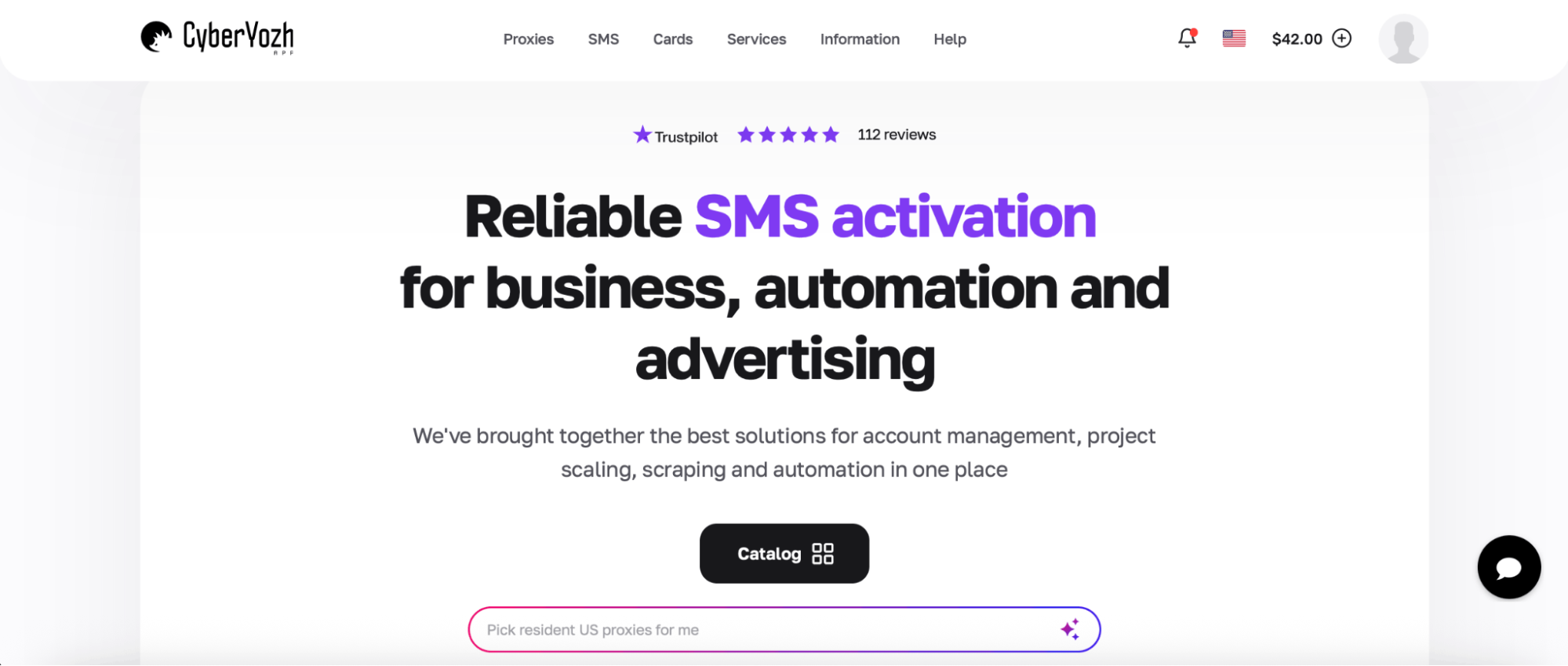

CyberYozh offers operational infrastructure for professionals running automation, scraping, advertising, and multi-account workflows at scale.
Unlike traditional proxy services, CyberYozh combines residential, mobile, and datacenter proxies in one platform with SMS activation, fraud-risk evaluation, and automation-ready APIs. This creates a unified environment where users can test, validate, and execute workflows without switching between multiple vendors or disconnected tools.
Key features:
-
- 50+ million residential IPs across 100+ countries with a 99.8% uptime for stable workflows
- Real mobile LTE/5G proxies with unlimited bandwidth for high-trust platforms
- Suitable for non-technical users with easy proxy management in one dashboard
- Sticky sessions and API-based IP rotation control
- API integration and full automation support (Scrapy, Selenium, Playwright, Puppeteer, Postman)
- Suitable for AI agents and automation systems that require stable residential IPs for continuous browsing, data extraction, and tool execution
- Fraud-score and risk evaluation tools for IPs, numbers, and cards
- OS and browser fingerprint control for account-based workflows.
- Affordable pricing starting from $0.9/GB.
Best for: automation-heavy workflows, multi-account management, SEO and SERP tracking, AI agents, scraping, and teams that need a single infrastructure layer for proxies, verification, and execution.
2. Bright Data – For enterprise-scale data collection
Bright Data is an established proxy provider mostly used by enterprises. It offers extensive geo coverage and extra tools for structured web data extraction. However, its complexity and pricing structure make it less accessible for smaller teams or beginners.
Key features:
- Large global IP network with city/ASN/carrier level targeting
- Compliance and enterprise-grade operational controls
- High pricing (typically $15–$30 per GB) compared to mid-market providers
- Steeper learning curve and complex setup for new users
Best for: Large enterprises running high-volume data collection and compliance-sensitive operations.
3. Oxylabs – For large-scale scraping
Oxylabs focuses on enterprise-level web scraping and data extraction, offering residential proxy networks and API-based tooling. It is mostly used for scalable scraping pipelines but is primarily designed for technical teams. For solo developers or small agencies testing the waters, Oxylabs can be excessive and costly.
Key features:
- Complex infrastructure solution for large-scale scraping and enterprise automation
- Robust APIs and developer-friendly integrations for Python, Node.js, and other stacks
- Pricing is geared toward enterprise budgets
- Less suitable for lightweight or entry-level users
Best for: Technical teams and enterprises running large-scale scraping and data pipelines.
4. Decodo – A mid-market residential proxy option
Decodo is positioned as a mid-market residential proxy provider that balances performance and cost. It is often chosen by teams that need proxies without the complexity or cost of enterprise-grade platforms. It focuses on usability and straightforward onboarding, making it accessible for growing businesses.
Key features:
- Decent but not extensive global coverage for common use cases – expect gaps in emerging markets
- User-friendly dashboard
- Suitable for scaling mid-sized operations
- Smaller feature set compared to enterprise providers
Best for: Mid-sized teams and businesses looking for cost-efficient residential proxy access.
5. IPRoyal – Budget-friendly option
IPRoyal is a residential proxy provider aimed at individuals, freelancers, and startups. It offers entry-level access to residential IPs, making it suitable for small-scale projects. While affordable, it does not match enterprise providers in infrastructure depth or advanced tooling.
Key features:
- Suitable for small‑scale scraping or testing tasks, not high‑concurrency production
- Global coverage for common regions
- Smaller IP pool compared to larger providers
- Limited advanced automation or enterprise features
Best for: Startups, freelancers, and users with small-scale or experimental workflows.
Final thoughts about best residential proxy providers
Choosing the right residential proxy provider in 2026 depends less on raw IP counts and more on stability, session control, and how well the infrastructure fits real workflows. The real differentiator is whether a provider can support consistent performance across automation, scraping, and AI-driven tasks under real production conditions. For teams that need a unified approach combining proxies, automation readiness, and workflow control in a single ecosystem, CyberYozh stands out as an infrastructure-focused option worth considering.
FAQs about best residential proxies
Can residential proxies be used for web scraping?
Yes, residential proxies help reduce blocks, CAPTCHAs, and rate limits by routing requests through real ISP-assigned IPs. This makes web scraping more reliable at scale.
Can you use residential proxies for SEO and SERP tracking?
Yes, they provide accurate location-based search results for keyword tracking, competitor analysis, and localized SERP monitoring.
Is it legal to use residential proxies?
Yes, residential proxies are generally legal to use. However, users must comply with applicable laws, regulations, and website terms of service.